Intrusion detection from air pressure. One module per floor.
No line of sight, no microphone, no camera, no cloud.
New — BaroAware Fusion: the same
pressure technology plus a 60 GHz radar, fused on one core. The breach for the volume,
the person for the room — with distance. Read about BA-FUSION-01 →
A building is a leaky box. Open a hole in it, and the pressure
inside changes — everywhere at once.
That last part is the whole product. At the frequencies involved the wavelength is many
times the size of the building, so there is no wave travelling and nothing to localise:
the enclosed air behaves as one volume. Open the envelope anywhere and the
entire volume responds together — through walls, around corners, into the room where the
module sits.
This is not acoustic detection. The module is not listening for a sound
arriving from somewhere; it watches the pressure of an enclosed volume change when that
volume is breached. It sees a door unlocked quietly with a key just as well as one forced.
Why this is not already everywhere
Measuring the pressure is the easy half. The other half is that wind against a façade
produces swings larger than the event you are looking for. So does a ventilation system
starting up. In amplitude, the signal-to-noise ratio is below one.
That kills the obvious approach outright. There is no threshold that catches a window and
ignores the weather — not a cleverer threshold, not a sharper filter, not a different band.
The two are separated by the shape of the disturbance in time and frequency,
not by its size.
So it is learned, not written
BaroAware runs a convolutional neural network trained on real recordings from an occupied
building — days and nights, in wind and rain, with people living normally inside. It runs
entirely on the microcontroller. No cloud, no gateway, no subscription.
Two things it deliberately stays silent on. Wind and turbulence can raise the pressure too,
and someone can lean on a door without opening it. BaroAware separates a real opening from
wind and from an impact without an opening, and does not alarm on those — it only notes them
in the log, as wind or impulse. A clearly strong intrusion always alarms,
so it is never “safe but blind”. Both gates can be switched on or off per sensor.
What the module sees
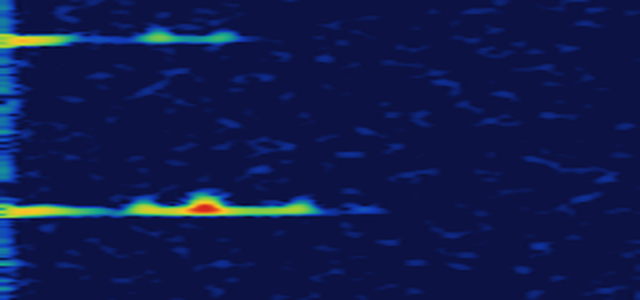
An unedited record from a BaroAware module in an occupied building. Time runs
upward. Two doors were opened — each one writes a bright band across the record. Everything
between them is the building breathing on its own.
Nobody had to tell the module those two moments were different from the rest. That is the
part that took the field data.
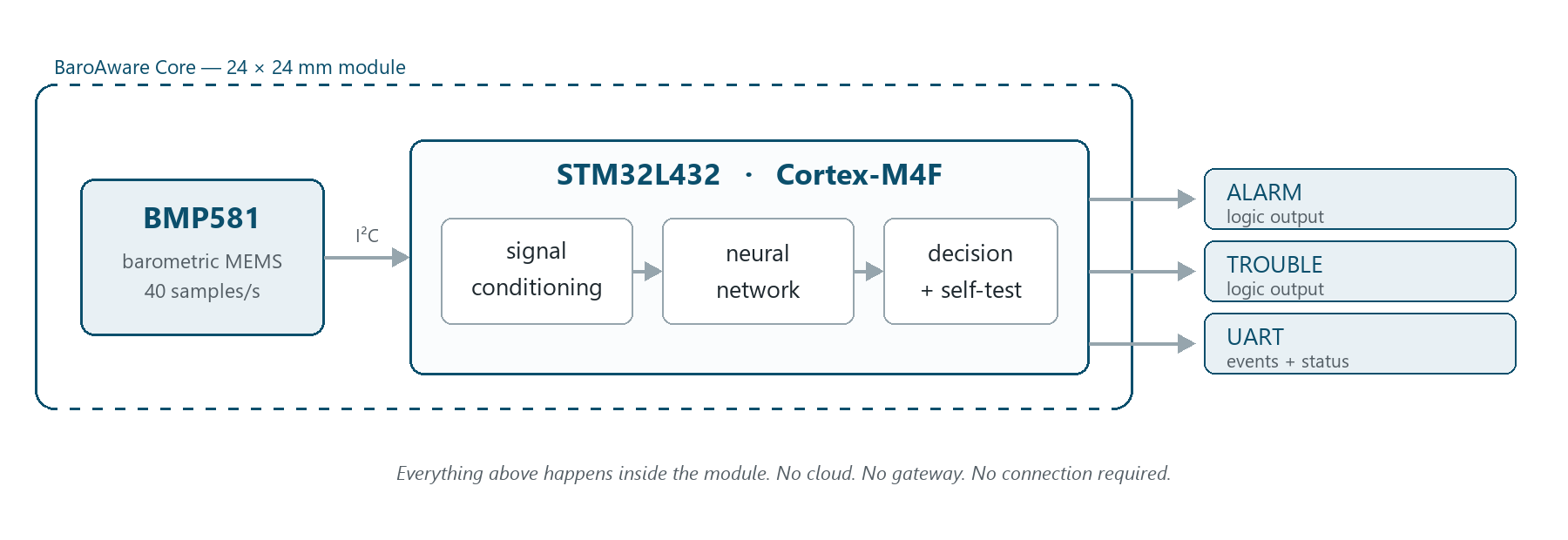
Sensor → neural network → UART and two hardware lines. The module decides on board.
What that buys the installer
Nothing to aim. No orientation, no coverage cone, no dead angles, no lens
to keep clean. It is a scalar measurement — direction does not exist.
Works in the dark, through smoke, behind furniture. There is no optical
path to obstruct, because there is no optical path.
One device per connected volume, not one per frame. In our own validation
a single module covers ≈140 m² (≈330 m³).
It cannot record anyone. Not “does not” — cannot. There is no microphone
and no camera on the board.
BA-CORE-01 — the module
In development. The board below is the
current revision. The detection technology it carries is already running in the field —
continuously, for months, on our own hardware. Evaluation units are being prepared; tell us if
you want to be on that list.
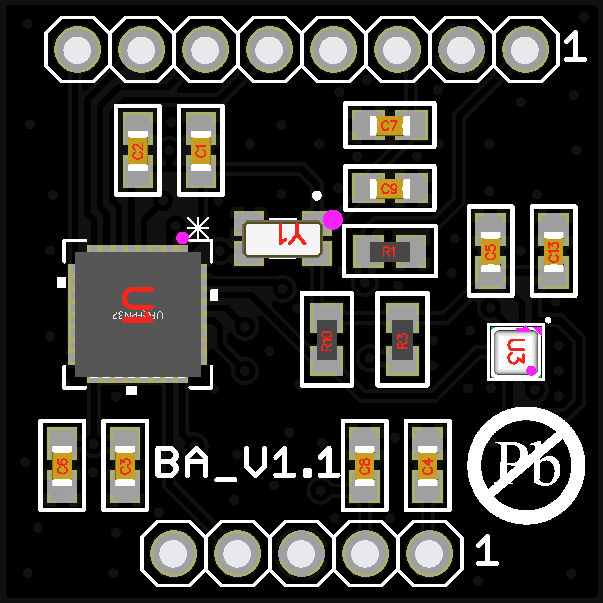
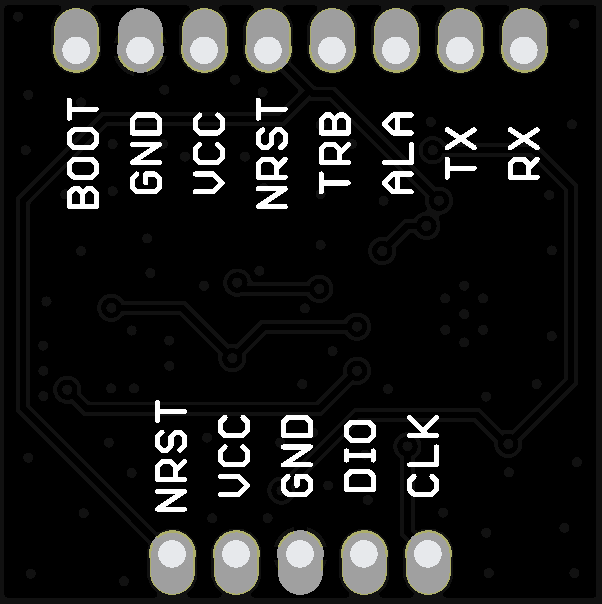
BaroAware Core, revision BA_V1.1 — component side and solder side.
CAD renders, 24 × 24 mm.
Size
24 × 24 mm
Supply
3.3 V only — all 5 V circuitry stays on the carrier board
Interface
UART, plus two logic outputs: ALARM and TROUBLE
Supply current
approximately 11 mA
Product code
BA-CORE-01
It connects to whatever the integrator already has: an
existing alarm panel, an ESP32 or Raspberry Pi, a PLC, a fieldbus node. The module decides on
board; the host only has to listen.
Development kit —
coming soon. The module on a carrier board, with an ESP32 alongside it.
What it does not do
One limitation, stated plainly: the module tells you that something was
opened — not which. If you need to know which window, you still need a contact on that window.
BaroAware tells you to go and look, and it does that from one point for the whole volume.
It complements an alarm system. It does not replace door contacts or motion
detectors; it covers a class of entry those miss.
Status
In development. The detection technology is validated in the field —
it has been running for months on our own hardware platform, on several units in a real,
occupied building, continuously. BaroAware Core is that technology in its final, compact form.
Evaluation units are available to integrators and distributors.
The serial interface specification is available on request.
Licensing & OEM
Available to integrators and OEMs as: evaluation units ·
pre-programmed modules for your own product ·
technology licensing · joint development.
The detection technology — the signal chain, the trained model and the field dataset —
remains with Micro-Elements; you build the product around it.
Start the conversation.
BaroAware
Detecție de efracție din presiunea aerului. Un modul pe etaj.
Fără linie de vizare, fără microfon, fără cameră, fără cloud.
Nou — BaroAware Fusion: aceeași
tehnologie de presiune plus un radar de 60 GHz, fuzionate pe un singur core. Breșa pentru
volum, persoana pentru încăpere — cu distanță. Citește despre BA-FUSION-01 →
O clădire e o cutie cu scurgeri. Deschide o gaură în ea, și presiunea
dinăuntru se schimbă — peste tot deodată.
Partea aceea din urmă e tot produsul. La frecvențele implicate, lungimea de undă e de multe
ori mai mare decât clădirea, deci nu există undă care să călătorească și nimic de localizat:
aerul închis se comportă ca un singur volum. Deschide anvelopa oriunde și
întregul volum răspunde împreună — prin pereți, după colțuri, până în camera unde stă modulul.
Nu e detecție acustică. Modulul nu ascultă un sunet care sosește de undeva;
veghează presiunea unui volum închis schimbându-se când volumul e spart. Vede o ușă descuiată
în liniște, cu cheia, la fel de bine ca una forțată.
De ce nu există deja peste tot
Măsurarea presiunii e jumătatea ușoară. Cealaltă jumătate e că vântul pe fațadă produce
variații mai mari decât evenimentul pe care îl cauți. La fel o instalație de ventilație care
pornește. În amplitudine, raportul semnal-zgomot e sub unu.
Asta omoară din start abordarea evidentă. Nu există niciun prag care să prindă o fereastră și
să ignore vremea — nici un prag mai deștept, nici un filtru mai ascuțit, nici o altă bandă.
Cele două se separă prin forma perturbației în timp și frecvență, nu prin
mărimea ei.
Așa că e învățată, nu scrisă
BaroAware rulează o rețea neuronală convoluțională antrenată pe înregistrări reale dintr-o
clădire locuită — zile și nopți, pe vânt și pe ploaie, cu oameni trăind normal înăuntru.
Rulează integral pe microcontroler. Fără cloud, fără gateway, fără abonament.
Două lucruri pe care tace deliberat. Vântul și turbulența pot și ele ridica presiunea, iar
cineva se poate propti în ușă fără s-o deschidă. BaroAware deosebește o deschidere reală de
vânt și de o lovitură fără deschidere și nu alarmează pe acestea — le notează doar în jurnal,
ca vânt sau impuls. O intruziune clar puternică alarmează întotdeauna, ca să
nu fie niciodată „sigur, dar orb”. Ambele porți se pornesc sau se opresc pe fiecare senzor.
Ce vede modulul
O înregistrare needitată de la un modul BaroAware într-o clădire locuită. Timpul
curge în sus. S-au deschis două uși — fiecare scrie o bandă luminoasă peste înregistrare.
Tot ce e între ele e clădirea respirând de una singură.
Nimeni n-a trebuit să-i spună modulului că acele două momente sunt diferite de rest. Asta e
partea care a cerut datele de teren.
Senzor → rețea neuronală → UART și două linii hardware. Modulul decide la bord.
Ce câștigă instalatorul
Nimic de orientat. Fără direcționare, fără con de acoperire, fără unghiuri
moarte, fără lentilă de ținut curată. E o măsurătoare scalară — direcția nu există.
Merge pe întuneric, prin fum, în spatele mobilierului. Nu există cale
optică de obstrucționat, pentru că nu există cale optică.
Un dispozitiv pe volum conectat, nu unul pe toc. În validarea noastră, un
singur modul acoperă ≈140 m² (≈330 m³).
Nu poate înregistra pe nimeni. Nu „nu o face” — nu poate. Nu există
microfon și nu există cameră pe placă.
BA-CORE-01 — modulul
În dezvoltare. Placa de mai jos e
revizia curentă. Tehnologia de detecție pe care o poartă rulează deja în teren — continuu, de
luni de zile, pe propriul nostru hardware. Pregătim unități de evaluare; spune-ne dacă vrei să
fii pe lista aceea.
BaroAware Core, revizia BA_V1.1 — fața cu componente și fața de lipire.
Randări CAD, 24 × 24 mm.
Dimensiune
24 × 24 mm
Alimentare
doar 3,3 V — toată circuitistica de 5 V rămâne pe placa purtătoare
Interfață
UART, plus două ieșiri logice: ALARM și TROUBLE
Curent de alimentare
aproximativ 11 mA
Cod produs
BA-CORE-01
Se conectează la ce are deja integratorul: o centrală de
alarmă existentă, un ESP32 sau Raspberry Pi, un PLC, un nod de fieldbus. Modulul decide la
bord; gazda doar ascultă.
Kit de dezvoltare —
în curând. Modulul pe o placă purtătoare, cu un ESP32 alături.
Ce nu face
O limitare, spusă direct: modulul îți spune că ceva s-a deschis — nu ce
anume. Dacă trebuie să știi care fereastră, tot ai nevoie de un contact pe fereastra aceea.
BaroAware îți spune să te duci să te uiți, și face asta dintr-un singur punct, pentru tot
volumul.
Completează un sistem de alarmă. Nu înlocuiește contactele de ușă sau
detectoarele de mișcare; acoperă o clasă de intrare pe care acelea o ratează.
Stadiu
În dezvoltare. Tehnologia de detecție e validată în teren — rulează de luni
de zile pe propria noastră platformă hardware, pe mai multe unități, într-o clădire reală,
locuită, continuu. BaroAware Core e tehnologia aceea în forma ei finală, compactă.
Unități de evaluare sunt disponibile integratorilor și
distribuitorilor. Specificația interfeței seriale e disponibilă la cerere.
Licențiere & OEM
Disponibil integratorilor și OEM-urilor ca: unități de evaluare ·
module pre-programate pentru propriul vostru produs ·
licențiere de tehnologie · dezvoltare comună.
Tehnologia de detecție — lanțul de semnal, modelul antrenat și setul de date de teren —
rămâne la Micro-Elements; voi construiți produsul în jurul ei.
Începe discuția.